Every governance platform asks you to do the exact same thing: wrap your agent in our SDK. Import the library. Rewrite your tool calls. Add our middleware.
And when you inevitably swap frameworks next quarter — you get to do it all over again.
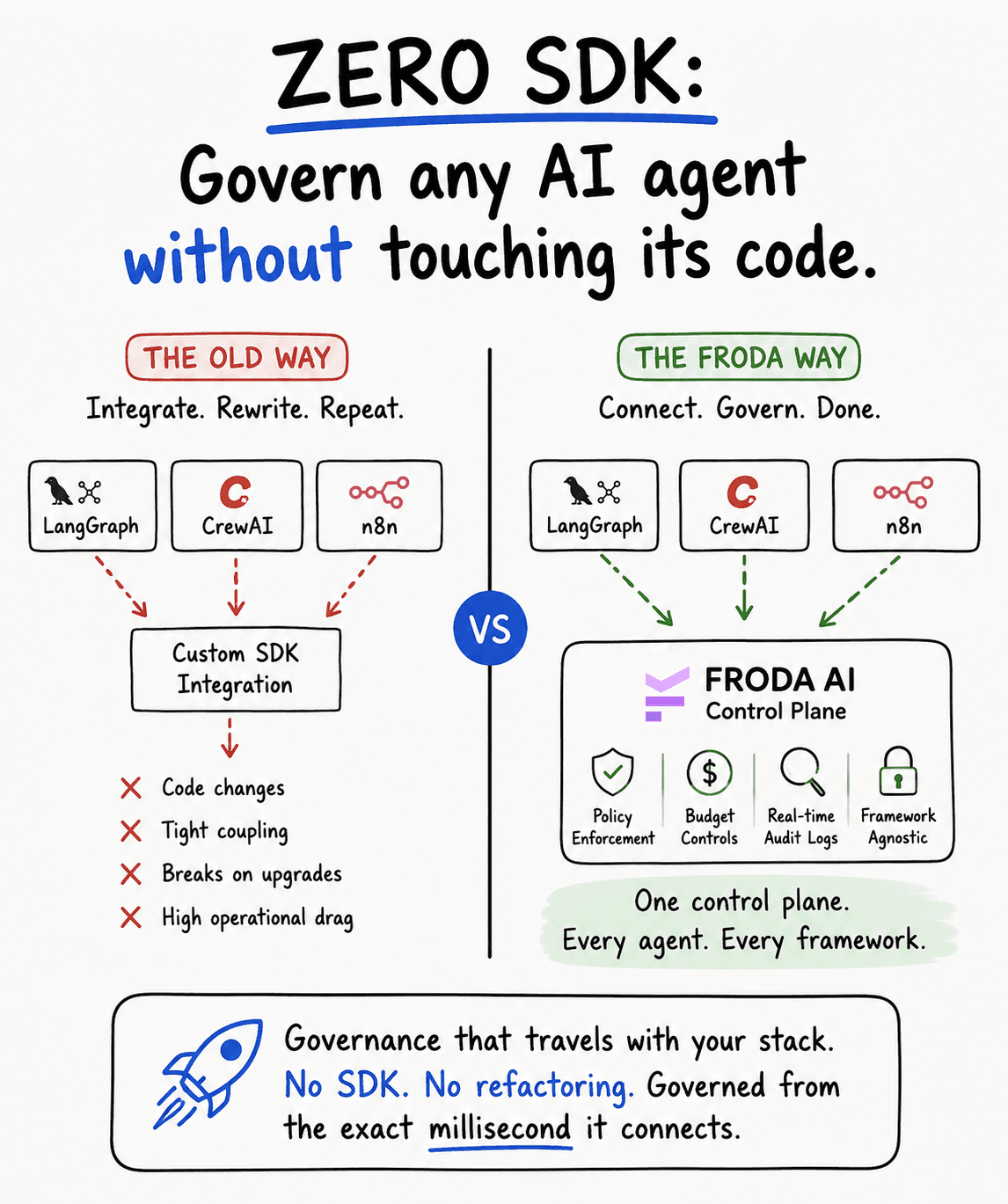
If your teams are currently running LangGraph for complex reasoning, CrewAI for prototypes, and n8n for quick workflows (because of course they are), that's three separate integrations to maintain. Three vendor coupling points. Three things destined to break on the next minor upgrade.
Governance in the wrong place
This approach is backwards. Governance shouldn't live inside your agent's code. It should live beneath it.
Every AI agent inherently does two things: it calls a model, and it calls tools. If you can govern those connection points externally, you govern the entire agent. No imports. No wrappers. No code changes.
The operational drag is real
The SDK-per-framework model is creating a massive operational bottleneck. PwC's 2025 Responsible AI Survey found that half of business leaders cite operationalization — turning high-level AI principles into scalable, repeatable processes — as their single biggest hurdle.
Adding a custom SDK integration per framework, per agent only deepens that bottleneck. Engineering teams don't have the bandwidth to play catch-up with every new GitHub repository their developers want to spin up.
What teams actually need: complete abstraction
The outcome teams need is a framework-agnostic control plane: you deploy your agent, and every policy, every budget cap, and every real-time audit log instantly applies. Same exact defensive behavior whether you built on LangGraph, CrewAI, n8n, or raw HTTP.
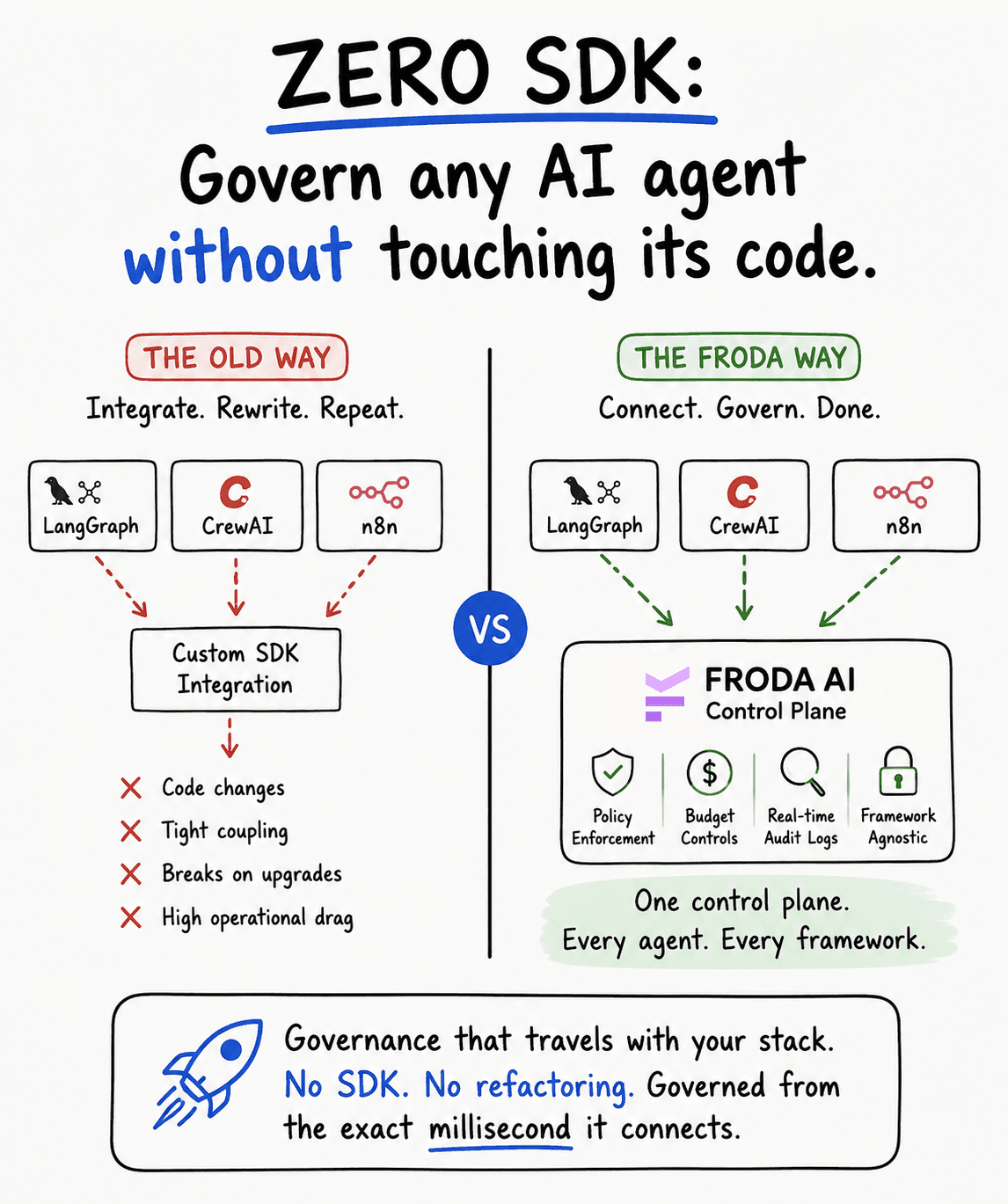
That's what we ship with Froda AI. We built the governance layer that travels with your stack, completely outside the application code. No SDK. No refactoring. Your agent is governed from the exact millisecond it connects.
How many custom governance integrations is your team maintaining today — and what breaks when you switch frameworks?
Froda AI provides runtime governance infrastructure for autonomous AI systems — helping teams discover, govern, enforce, and audit AI activity in real time, without changing a line of agent code. Request a demo.