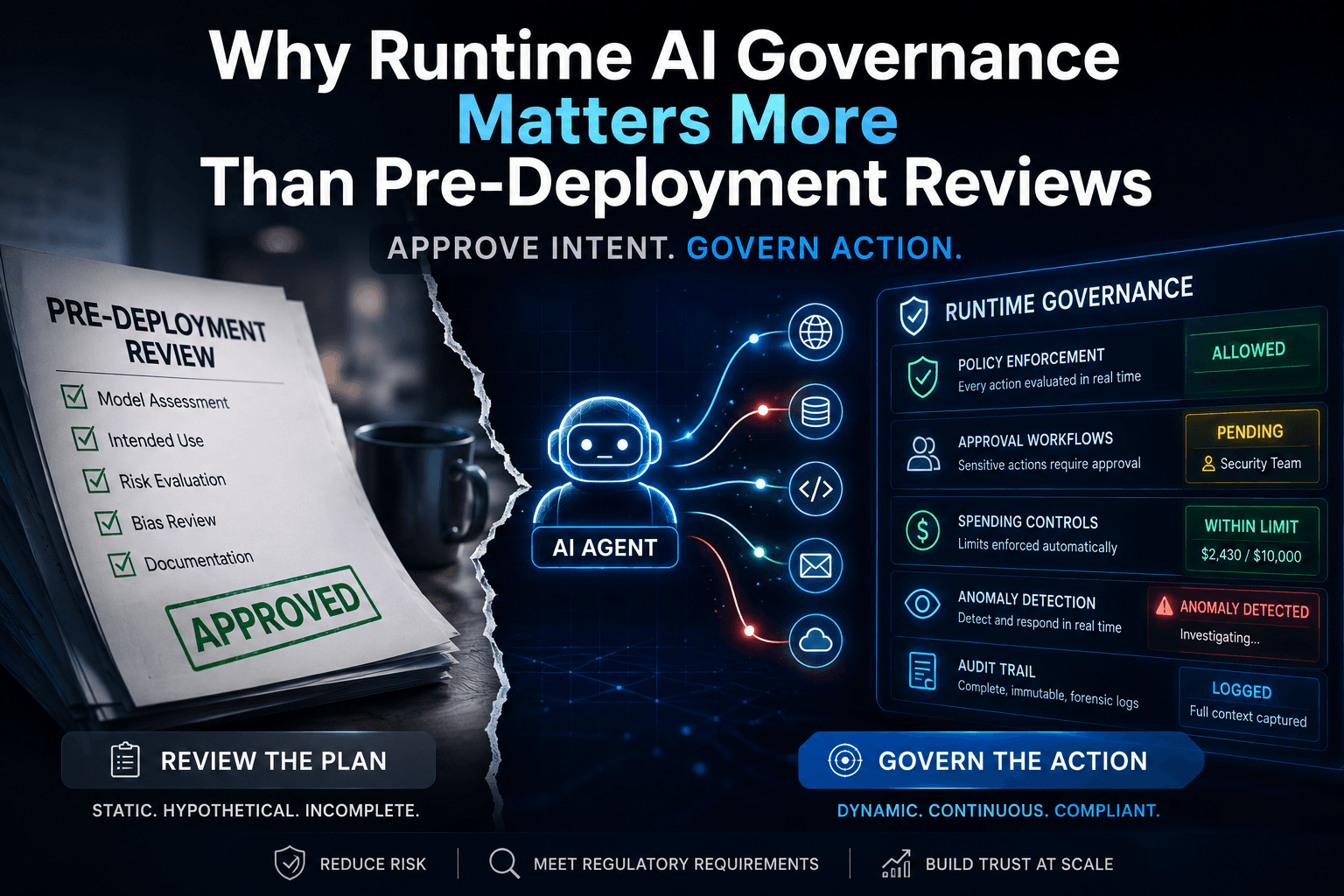
Most organizations approach AI governance like a checkbox exercise — review the model before deployment, document its intended use, and move on. But autonomous agents don't follow scripts. They make decisions in real time, call external tools, and interact with systems in ways that are impossible to fully anticipate during a pre-deployment review.
The Gap Between Plans and Reality
Traditional AI governance frameworks were designed for a simpler world: one where models were stateless, inference was a single request-response cycle, and human oversight meant a data scientist reviewing outputs in a notebook.
Agentic AI breaks every one of those assumptions:
- Agents are stateful. They maintain context across dozens of tool calls, accumulating permissions and information over time.
- Agents are autonomous. They decide which tools to call, what data to access, and how to sequence operations — often without human approval.
- Agents are composable. One agent can invoke another, creating chains of delegation that no pre-deployment review can fully map.
The result is a governance gap: the distance between what you approved and what actually happens in production.
What Runtime Governance Looks Like
Runtime governance means enforcing policies at the moment an agent takes an action — not days or weeks before deployment. It's the difference between reviewing a flight plan and having air traffic control.
Concretely, runtime governance provides:
-
Real-time policy enforcement — Every tool call is evaluated against your governance policies before it executes. Unauthorized actions are blocked, sensitive operations require approval, and spending limits are enforced automatically.
-
Complete audit trails — Every decision an agent makes is logged with full context: which policy applied, who approved it, what data was accessed, and what the outcome was. This creates the forensic timeline that auditors and regulators require.
-
Adaptive controls — Policies can respond to what's happening right now, not just what was anticipated during design. If an agent starts behaving anomalously — calling tools it never called before, accessing data outside its normal scope — runtime governance can detect and respond in real time.
The Regulatory Tailwind
This isn't just a best practice — it's becoming a regulatory requirement. The EU AI Act explicitly requires ongoing monitoring of high-risk AI systems, not just pre-market conformity assessments. ISO 42001 demands continuous governance processes, not one-time audits.
Organizations that rely solely on pre-deployment reviews will find themselves out of compliance as these frameworks mature.
Getting Started
The shift to runtime governance doesn't require ripping out your existing AI infrastructure. Modern governance platforms sit in the execution path of your agents — intercepting, evaluating, and logging every action without requiring changes to your agent code.
The question isn't whether you need runtime governance. It's whether you'll implement it proactively or be forced to retrofit it after an incident.
Froda AI provides runtime governance infrastructure for autonomous AI systems. To learn more about how we help teams discover, govern, enforce, and audit AI activity in real time, request a demo.