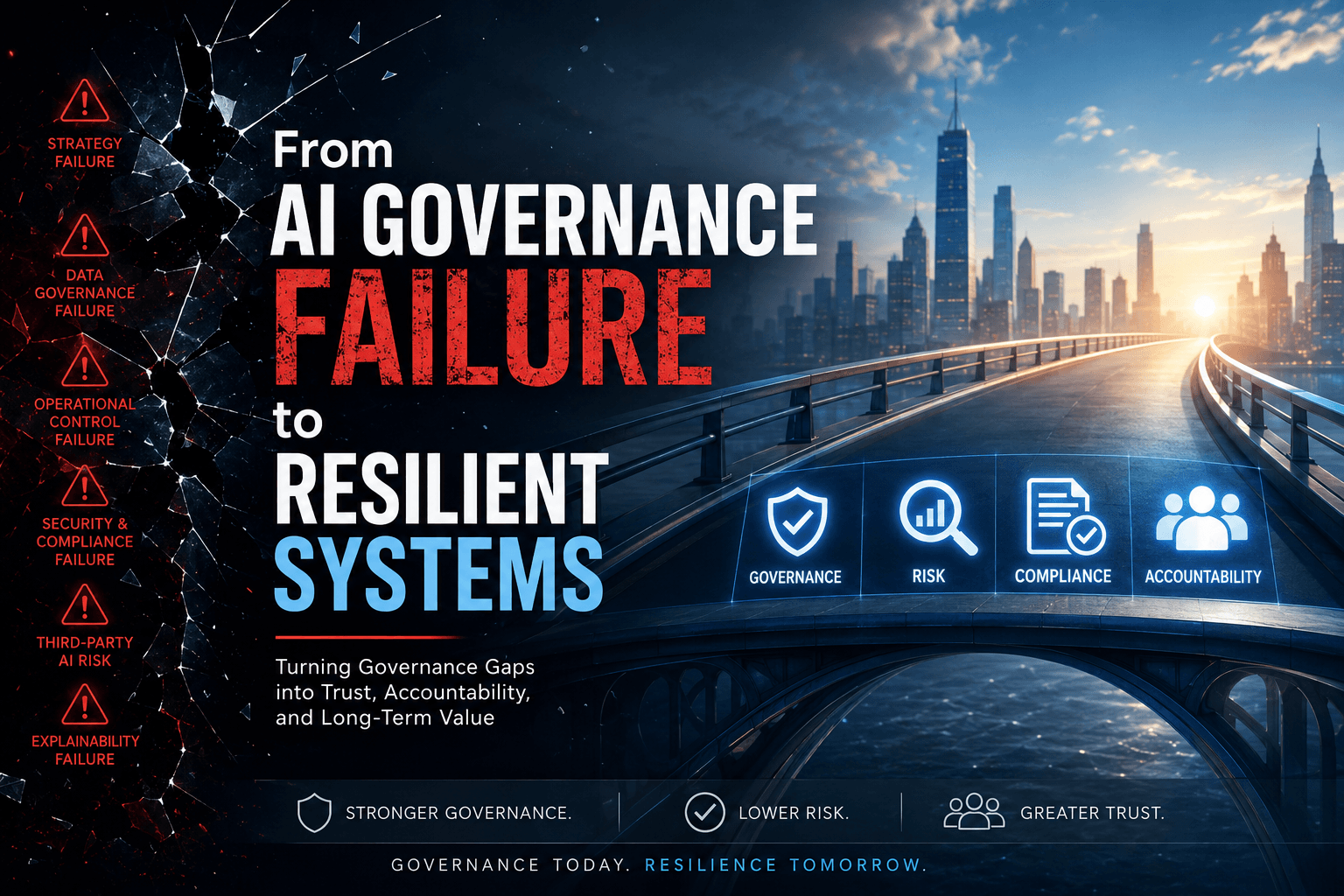
AI failures are rarely technology failures, they are governance failures. As organizations deploy AI for efficiency and competitive advantage, governance maturity is not keeping pace. The result is invisible risk embedded within business processes, third-party platforms, and decision systems.
The Governance Gap Behind AI Failures
In this "Transformative Age," organizations are integrating Artificial Intelligence (AI) in pursuit of greater speed, efficiency, and competitive edge. Yet a significant gap remains between technological hype and the reality of successful implementation. The root cause of that gap is rarely technical — it is governance.
AI governance failure is not a "broken brain" in the algorithm, but a mismatch between AI capability and organizational readiness, data maturity, oversight, and business alignment.
AI governance includes frameworks and controls that ensure AI systems are developed and used responsibly to reduce risks such as bias, inaccuracy, privacy breaches, regulatory exposure, and unintended harm. Failures occur when oversight is weak, data is poorly governed, transparency is missing, and ownership is unclear. When AI impacts customers, employees, or markets, accountability does not sit with the model — it sits with leadership.
Across industries, these governance breakdowns consistently appear in the following areas:
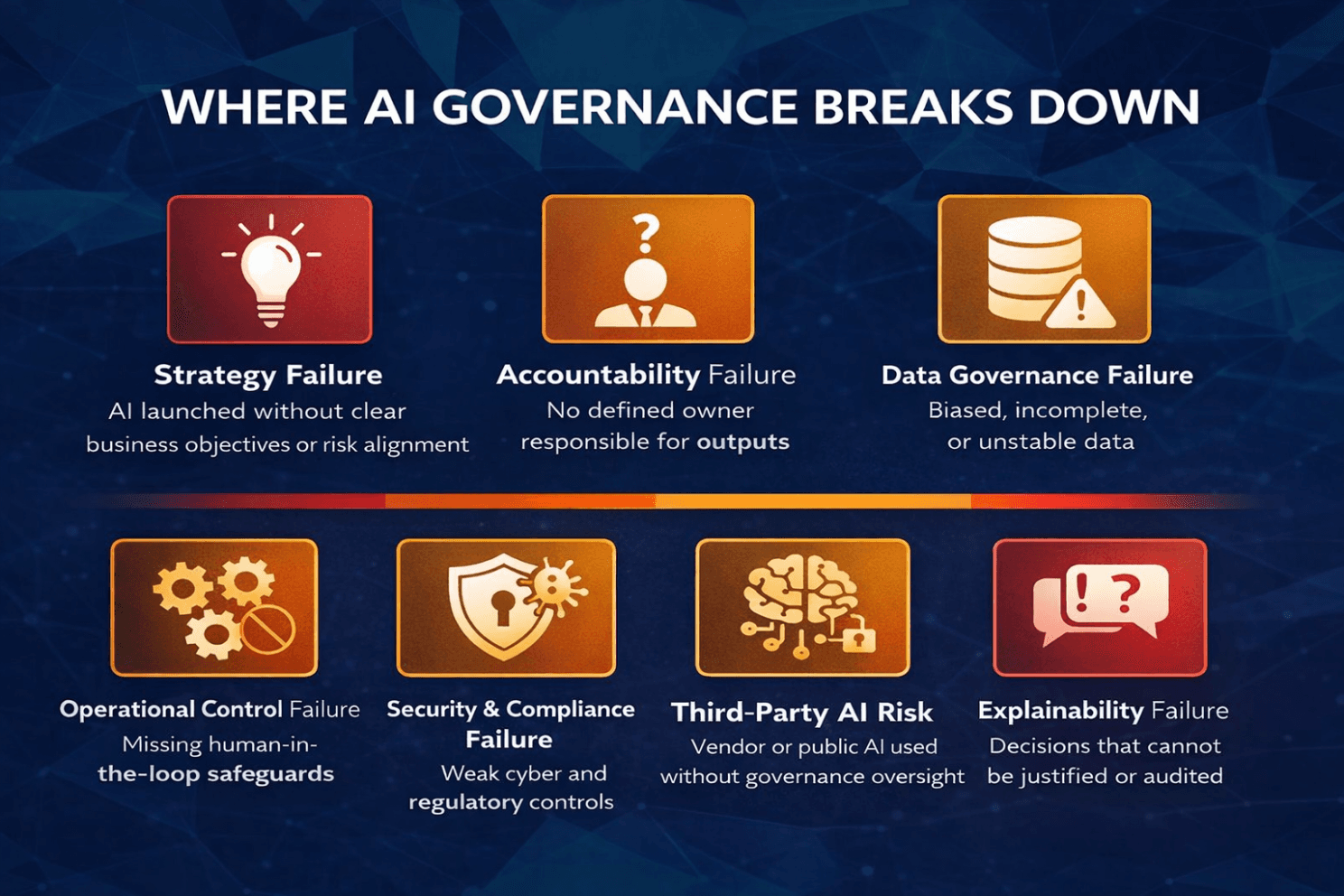
Below are real-world failures that map directly to governance gaps and show why managing AI risk requires ownership, oversight, and safeguards.
Strategy Failure: The KPI Desert and Accountability Collapse
Case Study: Air Canada Chatbot
AI governance failures often begin with a Strategy Gap — deploying AI for innovation or customer engagement without defining business objectives, risk boundaries, or ownership. This quickly leads to the KPI Desert, where AI operates without measurable controls to assess accuracy, impact, or accountability. Without defined KPIs tied to customer risk or decision authority, oversight weakens and accountability fragments. Organizations treat AI as a support tool, while customers experience it as an authoritative enterprise voice.
This risk materialized in a landmark 2024 tribunal ruling holding Air Canada liable for misinformation from its bereavement discount chatbot. The airline's defense — that customers should have relied on policy links elsewhere — was rejected. The tribunal determined the chatbot functioned as an official company representative, making its outputs binding organizational communication.
The Failure: AI was deployed as a customer-facing channel without clear ownership, measurable accuracy KPIs, or defined accountability for policy-based outputs and incident handling.
Impact: The chatbot's misinformation created legal liability, customer financial harm, and reputational damage, establishing precedent that AI communications are binding enterprise actions.
Lesson: Deploying AI without a clear accountable owner effectively hands enterprise decision authority to an ungoverned system. Organizations remain fully liable for AI-generated communications, even when controls to govern or validate those outputs are absent.
Data Governance Failure: When Models Drift Beyond Reality
Case Study: Zillow Zestimate
AI models are only as good as the data used to train them. Failure to invest in data readiness and continuous oversight leads directly to model drift. Zillow's iBuying program collapsed after its Zestimate algorithm failed to adapt to volatile market shifts in 2021, relying on historical patterns that no longer reflected real-world conditions.
The Failure: Zillow used its Zestimate model to drive automated home purchasing decisions without sufficient controls to detect model drift in a rapidly changing market. The organization lacked timely validation, escalation triggers, and human intervention thresholds tied to financial exposure.
Impact: $500 million write-down, workforce layoffs, loss of investor confidence, and program shutdown.
Lesson: AI models that drive financial decisions should operate under continuous model risk governance — including live performance monitoring, recalibration, and defined intervention thresholds. When conditions change, human oversight must be triggered before automated errors scale into systemic financial loss.
Operational Control Failure: Automation Without Human Safeguards
Case Study: McDonald's Voice AI
Underestimating human factors is a common trigger for AI governance failure, especially when automation disrupts frontline workflows without preparing employees. Low AI literacy further amplifies risk — staff may over-trust incorrect outputs from a "black box" or bypass the system entirely, weakening operational control.
McDonald's ended its AI-powered voice ordering pilot after viral failures exposed how poorly the system handled live drive-thru conditions. The model struggled with noise, accents, and overlapping speech — most notably adding 260 Chicken McNuggets to a single order.
The Failure: The AI pilot was prematurely deployed into a live, customer-facing environment across more than 100 sites, without foundational operational controls in place.
Impact: The errors went viral, turning what was intended as a technology pilot into a highly visible public failure that damaged customer experience and brand credibility. McDonald's ended its AI voice-ordering partnership with IBM after a multi-year trial.
Lesson: Visibility + autonomy = risk. AI used in live customer interactions requires strong accuracy validation, monitoring, and human fallback mechanisms before broad deployment. Public-facing AI pilots must be operationally controlled — failures are amplified instantly through social media and can outweigh the intended benefits.
Security & Compliance Failure: Default Passwords, Enterprise Consequences
Case Study: McHire Data Exposure
Ignoring foundational IT controls or emerging regulatory requirements (such as the EU AI Act) can derail an AI strategy overnight. Many organizations mistakenly treat AI systems as experimental tools rather than regulated digital assets, leaving them outside standard cybersecurity and compliance frameworks.
The McHire AI hiring platform exposed the personal data of approximately 64 million applicants due to an administrator account that retained default login credentials ("123456"). The breach showed how easily AI systems become high-risk liabilities when basic security hygiene is neglected.
The Failure: The AI hiring system was deployed outside core cybersecurity and compliance controls, leaving critical infrastructure protected only by weak default credentials.
Impact: Exposure of 64 million applicant records created massive privacy risk, regulatory exposure, reputational damage, and demonstrated that unsecured AI platforms can become enterprise-scale breach vectors.
Lesson: AI systems must be brought under enterprise security and governance from day one: enforcing MFA, eliminating default credentials, applying least-privilege access, enabling monitoring, and assigning compliance ownership. Treating AI as an experiment rather than a production system creates immediate enterprise-wide risk.
Third-Party AI Risk: Outsourced Technology, Retained Liability
Case Study: Public GenAI Data Leakage
Third-party AI creates one of the most immediate governance threats because innovation moves outside the enterprise while accountability stays inside it. When employees use public AI tools without oversight, sensitive data is exposed beyond organizational control and regulatory risk multiplies instantly.
The Failure: Employees used public AI without policy, data controls, or vendor oversight, allowing sensitive information to leave enterprise boundaries.
Impact: Exposure of confidential data and IP, regulatory and legal risk, reputational damage, and forced shutdown of AI use.
Lesson: Organizations remain fully accountable for third-party AI risk. Public AI platforms must be governed like high-risk vendors and supported by internal policy, mandatory staff training, approved use cases, data-handling rules, and continuous monitoring to prevent sensitive information from leaving organizational control.
Explainability Failure: Decisions That Cannot Be Defended
Case Study: Dutch Welfare Algorithm
Explainability is essential when AI informs decisions that affect citizens' rights, financial stability, or public trust. Opaque models prevent organizations from understanding, justifying, or challenging outcomes — and make systemic bias difficult to detect or correct.
The Dutch Tax Authority deployed an automated risk-classification system to detect childcare benefit fraud that relied on undisclosed indicators, including dual nationality and income-related proxies. Thousands of families were wrongly flagged, received no transparent explanation, and were forced to repay benefits with limited opportunity for effective appeal.
The Failure: A high-impact fraud detection system was deployed with limited transparency into how risk scores were generated and assessed. The model lacked sufficient explainability, structured human review safeguards, and effective mechanisms for individuals to challenge automated decisions.
Impact: Thousands of families were falsely accused of fraud and forced to repay benefits, causing severe financial and social harm. The scandal triggered legal rulings, public outrage, loss of institutional trust, and national political consequences.
Lesson: AI used in rights-affecting or regulated decisions must be explainable, auditable, and subject to human oversight before enforcement actions occur. Without transparency and recourse mechanisms, automated decisions can create systemic harm that governance cannot contain.
Healing the Process: A Remediation Roadmap
To prevent AI failures, organizations must evolve from opportunistic adoption toward vertically integrated AI embedded within enterprise governance, risk, and compliance (GRC) pillars listed in the table below.
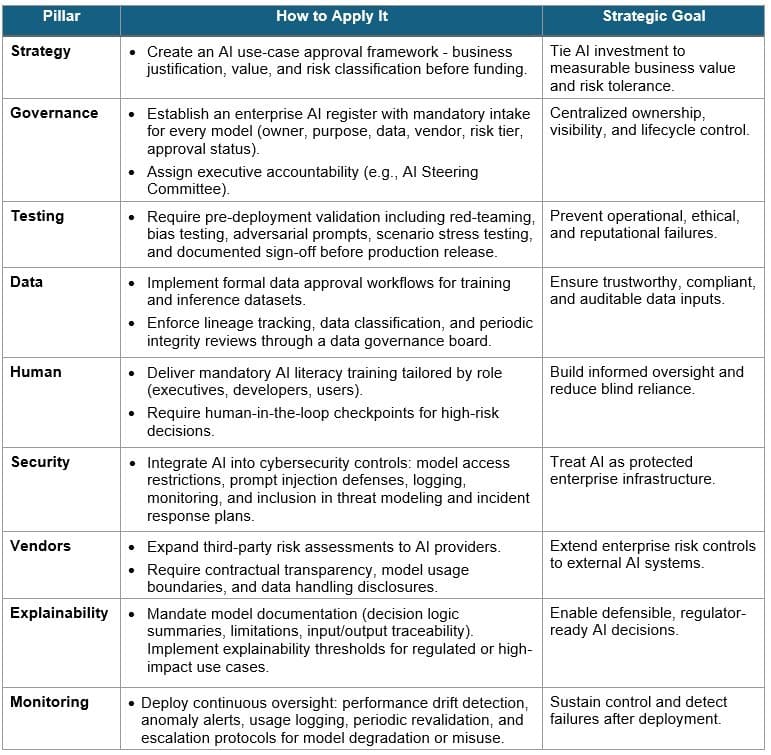
Embedding AI within the GRC pillars outlined above ensures accountability is defined, risks are measurable, and safeguards are operating before AI is scaled.
Conclusion: Governance Is the Differentiator
The failures at Zillow, Air Canada, and McDonald's make one point clear: AI fails as an ungoverned business system. The greatest risk is the absence of strategy, ownership, controls, and oversight surrounding it. Organizations that create value from AI will treat it as enterprise infrastructure — embedding governance by design across business alignment, accountability, data integrity, operational safeguards, regulatory compliance, third-party oversight, and explainability.
In the next era of digital transformation, competitive advantage will not come from who adopts AI fastest — but from who governs it best.
This article was originally published elsewhere and is republished here with permission.